
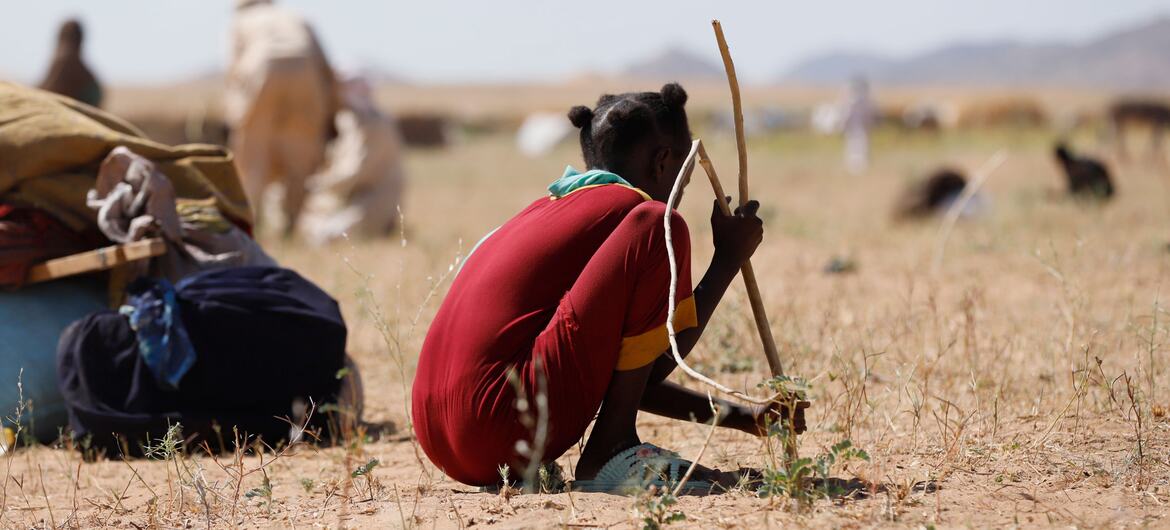
In Sudan, positional fighting continues between the SAF and RSF, primarily in Darfur, Kordofan, and the Blue Nile. Neither side has achieved a decisive advantage; however, attacks, sieges of cities, and the use of drones against civilian targets are exacerbating the destruction of infrastructure and increasing casualties.
The humanitarian crisis is deepening: millions of people are in need of assistance, the scale of displacement and hunger is growing, and camps are overcrowded. Education and healthcare are virtually paralyzed, and cholera is spreading. The parties to the conflict are attacking civilians, medical facilities, and displaced persons' camps, as well as conducting arbitrary detentions.
Fighting continues in Sudan, and the humanitarian situation is deteriorating month by month. The last report on Sudan was released in July. We regret to note that the situation has only worsened since then.
Frontline situation
Military actions between the Sudanese Armed Forces (SAF) and the Rapid Support Forces (RSF) have taken on a positional character. Neither side can achieve a convincing military victory. We note minor advances by both sides along the front line.
Major combat operations cover several regions: Darfur, Kordofan, and the Blue Nile.
Darfur remains the epicenter not only of hostilities but also of war crimes, including mass killings. After the capture of a major city in Darfur — El Fasher — the RSF have strengthened their positions in the region. At the same time, the humanitarian situation has worsened.
Fighting continues in both the northern and southern parts of Kordofan. The administrative center of North Kordofan, El Obeid, is practically under siege. The RSF advancing on the city have decided not to attack it head-on but to use a strategy of attrition to make life in the city impossible. The city is regularly subjected to drone attacks, which the RSF use to strike urban infrastructure.
The RSF are also advancing in the Blue Nile area. Their forces are reported to be making progress towards Ed Damazin — the administrative center of the state.
Humanitarian Situation
Scale of the crisis
The humanitarian crisis in Sudan remains one of the most severe in the world. Since July 2026 of this year, there has been no significant improvement in the humanitarian situation, and in some areas, we note a deterioration.
About 7 million people are in need of humanitarian assistance, about 17 million children are in need of support. Compared to July, the number of displaced persons may have increased from 9 million up to to 11.8 million people.
6 million people are facing food shortages. Most of them are forced to go without food for several days, and 2 million people are already experiencing hunger or are on the brink of it.
The situation is also worsening in refugee camps. The camp in North Darfur, in Tawila, is overcrowded. It currently houses over 650 000 people. Due to a lack of space, most people are forced to build temporary shelters from improvised materials. Newly arrived families are accommodated in the beds of dried-up rivers, which regularly suffer from flooding.
The humanitarian situation is critical. Thousands of children, as well as pregnant and breastfeeding women, are on the brink of extreme malnutrition. The camp lacks even basic resources.
Access to education
The education system in Sudan remains paralyzed. Over 8 million children are forced to learn outside of school. The situation is particularly severe in Darfur and Kordofan. Most schools are used as shelters for displaced persons. Access to education and exams is only maintained in stable areas.
We can speak of the formation of a lost generation. Most children cannot receive an education due to ongoing violence and displacement from one region to another.
The state of the healthcare system
The healthcare system is also paralyzed. Many hospitals and clinics have been destroyed. The parties to the conflict use social facilities as shelters and storage places for ammunition. Doctors are forced to work under harsh conditions: under the threat of violence and with a shortage of medications. As a result of targeted attacks, 1600 patients and medical workers have died.
В 2026 In the past year, the country has repeatedly recorded outbreaks of cholera. The situation is particularly severe in North Darfur and Kordofan.
War Crimes
The parties continue to carry out targeted attacks against the civilian population. 27 October was struck drone strike on the Tangkong market in South Darfur, which is under the control of RSF. As a result of the strike, more than 110 people were killed, including women and children. We emphasize that the market was a civilian object, although RSF fighters may have been nearby.
Attacks on camps and places of displacement continue. 9 On October, an RSF drone attacked a group of refugees near the Blue Nile. Killed 31 people.
11 October RSF drone struck a hospital Umm-Darfa in the Blue Nile state. The hospital ceased operations, and medical workers were injured.
It should be noted that SAF resumed arbitrary detentions in El-Obeid on suspicion of collaboration with RSF. Thus, in a prison designed for 450 people, there may be more than 2000 detainees.
We note a sharp increase in the use of drones against civilian objects. In the first three weeks of October, as a result of drone strikes, 306 civilians were killed.
Conclusion
The situation in Sudan indicates the protracted nature of the conflict and the deepening humanitarian crisis. Positional fighting does not bring either side closer to a decisive victory, but continues to destroy the living conditions of the civilian population. Darfur, Kordofan, and the Blue Nile remain the main hotspots of violence. Strikes on infrastructure, sieges of cities, and attacks on places of displacement exacerbate the consequences of the war far beyond the immediate front line.
Since July, there has been no significant improvement in the humanitarian situation. Mass displacement, food shortages, and overcrowding in camps are accompanied by the destruction of education and healthcare systems. Children, pregnant and nursing women are particularly vulnerable. Inaccessibility to education creates the risk of a lost generation, while the lack of medical assistance and cholera outbreaks exacerbate threats to people's lives.
The attacks against civilians and arbitrary detentions described in the review show that the humanitarian consequences of the conflict cannot be viewed separately from the actions of its participants. The increasing use of drones against civilian objects makes the protection of the population one of the key tasks.


 Russian
 English