
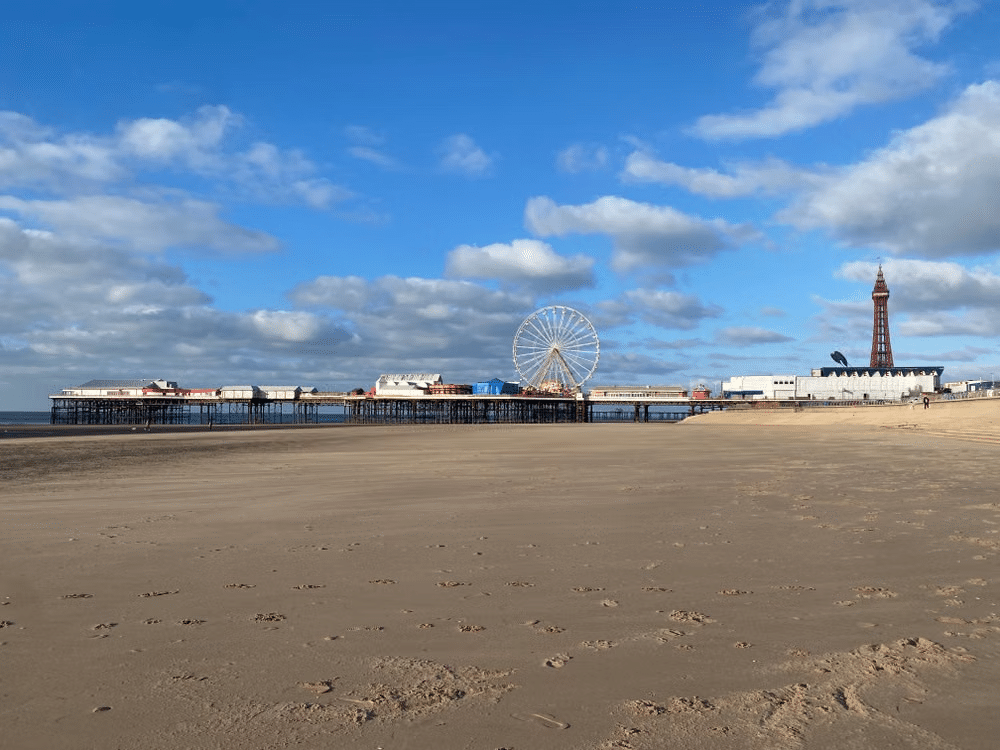
In Blackpool, the rate of teenage pregnancy is significantly higher than the average in England: in 2023, about 65 conceptions were registered among girls under 18, with a rate of about 28 cases per 1000 compared to 13.5 nationwide. After a decline since 2004, the number of cases has risen again since 2020.
The study links the problem to poverty, family dysfunction, domestic violence, substance abuse, low levels of education, and limited life prospects. Early pregnancy can lead to school dropout, psychological stress, and increased vulnerability, so support measures must address the root causes.
We continue the cycle of research on Europe. Next up is Blackpool; you can find the other studies on Europe. here.
Blackpool is located on the coast of the Irish Sea in Lancashire. Many readers of our project may associate Blackpool with the promenade and the famous Blackpool Tower, which was built back in 1894 to attract tourists and somewhat resembles the Eiffel Tower.

From a tourist center to a deprived city
The city gained its fame right in the mid-19th century. Only if Middlesbrough it became one of the key cities of industry, Blackpool turned into a tourist center of England. In 1846, the railway connected Blackpool with other areas of North England, making it accessible to working families from Lancashire cities. By the beginning of World War II, the city welcomed about 10 million tourists a year. This is one of the best indicators of domestic tourism.
Naturally, the city's economy began to build around tourism. Not industry, typical for most cities, but tourist infrastructure became the foundation for development. Hotels, guesthouses, restaurants, and entertainment centers began to appear in the city.
However, since the late 1960s, the situation began to change. The development of air travel made flights accessible for British families, and package tours attracted with their simplicity. This began to lead to a gradual decline of the city and urban infrastructure. Guesthouses lost patrons, and excess properties began to be converted into small private apartments and rental rooms.
Property prices fell, attracting socially vulnerable residents from other parts of England. In many central districts, a concentration of poverty, violence, social deprivation, and crime began to form.
For this reason, Blackpool by the end of 2025 ranked first among English municipalities in the multiple deprivation index (this index measures how socially deprived an area is compared to other areas, that is, the accumulation of various types of deprivation).
In this study, we do not intend to examine crime in Blackpool, so we have narrowed the subject of research. We will consider the issue of early teenage pregnancy in the city, its causes, and consequences.
The problem and its scale
Early teenage pregnancy is a problem in itself. But what is the cause, and can we say that early pregnancy is a consequence of social deprivation?
In Blackpool in 2023, approximately 65 conceptions were registered among girls under 18, of which 15 cases involved girls under 16.
The rate of early pregnancy among teenagers under 18 was approximately 28 cases per 1000 girls,, while the average rate across England is 13.5 cases. Thus, the level of early pregnancy exceeds the national average by more than two times. However, the current estimate is better than the figures from the early 2000s. The number of teenage pregnancies has decreased by 61% compared to 2004.
However, the COVID-19 pandemic made its adjustments. After 2020, the number of conceptions began to rise again. In 2021, 46 cases were registered, in 2022 about 60, and in 2023 already 65 cases. Temporary isolation led to the disruption of usual social connections, as well as a deterioration in the economic situation of British families, which resulted in an increase in crime and domestic violence. We cannot assert with 100% certainty that the sharp rise in pregnancy cases is directly related to COVID-19, but it is clear that this could have been one of its consequences.
Within the city itself, there is also a strong disparity between neighborhoods. In some areas, teenage pregnancy may exceed both the city and national levels, indicating the depressed condition of certain territories.
Blackpool ranks third in England. Higher values were recorded in Middlesbrough and North East Lincolnshire.
How does the crime situation in the city affect this?
The high level of teenage pregnancy is caused by a combination of factors: poverty, low educational attainment, family instability, and living in areas with high crime rates.
Poverty and family instability
In 2024-2025, approximately 5% children under 16 in Blackpool lived in families where the income level was below 60% of the median. Meanwhile, across England, this figure does not exceed 19.8%. Teenagers also face a high level of domestic violence. In Lancashire (including Blackpool), over 2000 criminal prosecutions for domestic violence were recorded in 2024, which is 5% higher than the average level across England.
Drug use has also increased. Since 2013, this figure has risen by 201%. The mortality rate from drugs here is four times higher than the average in England. Adolescent addiction is also a concern. About 61% of 11-year-olds and 231% of 15-year-olds have used drugs at least once. As for alcohol consumption among minors, it also exceeds the average figures in England.
We are observing a trend of increasing psychoactive substance use among adolescents. This reduces self-control and leads to an increase in the number of unprotected sexual contacts, especially at parties where prohibited substances are present.
Regarding domestic violence, a direct correlation can be established here. Adolescents who have experienced episodes of violence in the family are initially in a more vulnerable position, which may increase the risk of early pregnancy.
Education and life prospects
A low level of education is directly linked to the criminal situation. Adolescents are more often involved in criminal gangs and participate in committing crimes, as in Middlesbrough. There are criminal groups in the city consisting of adolescents. For example, an 11-year-old boy was the head of a criminal network that included about 80 criminal gangs. Early involvement of young people in destructive groups reduces school attendance, which ultimately leads to a decrease in the level of education.
Consequences of early motherhood
All these problems that have accumulated in the city can affect early adolescent pregnancy. And yes, adolescent pregnancy is a serious issue. A teenager finds themselves unprepared for new responsibilities and often seeks to start working as soon as possible to support themselves and their child. This leads to young parents dropping out of education. Additionally, serious psychological stress arises. As a result, the teenager finds themselves in a vulnerable position. Social services need to be more actively involved in addressing youth issues and creating both necessary institutional solutions and appropriate infrastructure.
The fight against deprivation and adolescent pregnancy must include addressing the root causes of the situation. Fighting only the consequences means fighting windmills.
Poverty and family instability
Traumatic experience
Dropping out of the education system and weakening social support
increased vulnerability and risk of unplanned pregnancy
Conclusion
Blackpool shows a simple thing: adolescent pregnancy is not just a personal story of an individual girl, but a signal that the support system around adolescents is failing. Where there is poverty, violence, weak education, and little hope for the future, the risk of early pregnancy becomes higher.





 Russian
 English