![[sub]text](https://subtext-lab.com/wp-content/uploads/2026/01/white_transp-scaled.png)
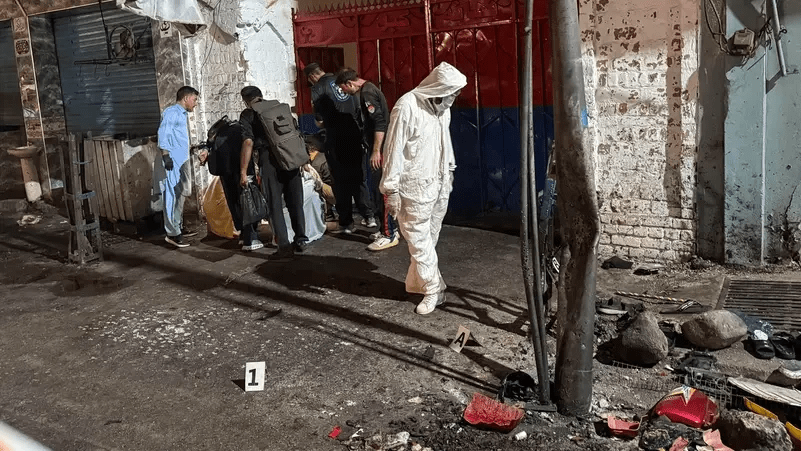
In Pakistan, the level of violence sharply increased in 2026, especially in Khyber Pakhtunkhwa and Balochistan. In the first seven months, thousands of attacks were recorded, with hundreds of civilian and security forces casualties, as well as population displacement and worsening humanitarian conditions.
Suicidal attacks, drone use, kidnappings, and assaults on civilian infrastructure have been reported. Cooperation between the TTP and BLA has intensified, while authorities respond with large-scale counter-terrorism operations and raids without negotiations with militants.
Pakistan in 2026 continues to face an unprecedented rise in violence, with the most severe situation observed in Khyber Pakhtunkhwa and Balochistan. Several terrorist organizations operate in Khyber Pakhtunkhwa, including the Islamic State Khorasan (ISKP)*and the Pakistani Taliban (TTP)*.
*The organization is recognized as terrorist in several countries, including the Russian Federation, where its activities are banned.
Current Situation
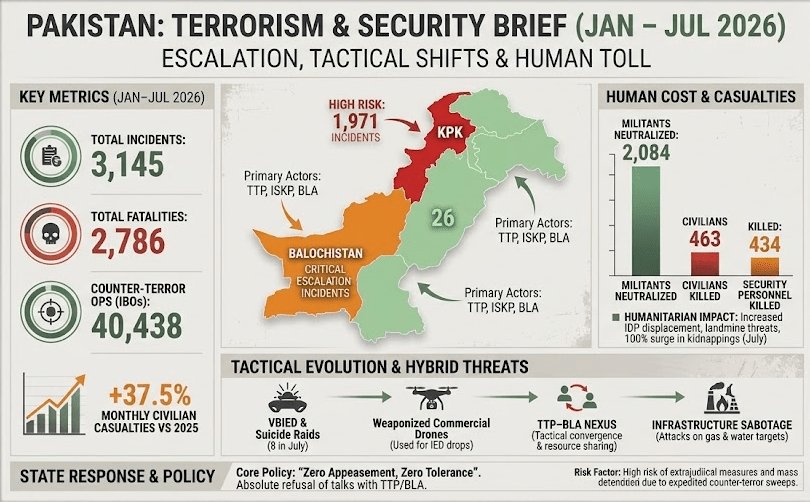
In the first 7 months of 2026, approximately 3,145 terrorist incidents were recorded across the country. 1,971 occurred in Khyber Pakhtunkhwa, 1,148 — in Balochistan, and 26 — in other regions.
Casualties and Injuries
In the first seven months of 2026, in Pakistan died more than 463 civilians, and hundreds were injured. This reflects a persistent trend: terrorist groups increasingly target areas with high population density — markets, religious gatherings, protests, transportation hubs.
Additionally, 434 security personnel, including the army, police, and other security forces, were also killed. This indicates that militants systematically attack state infrastructure, checkpoints, patrols, military convoys, and police stations.
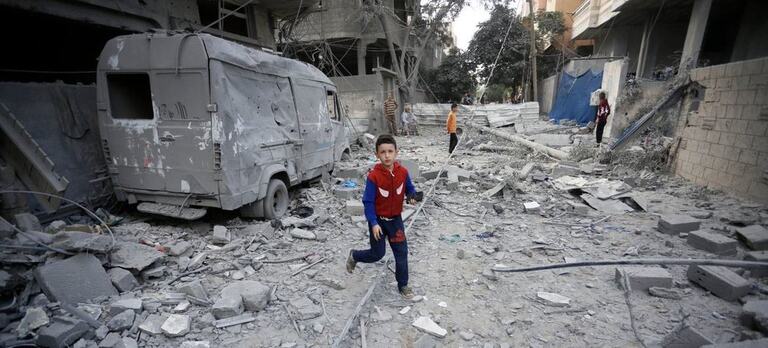
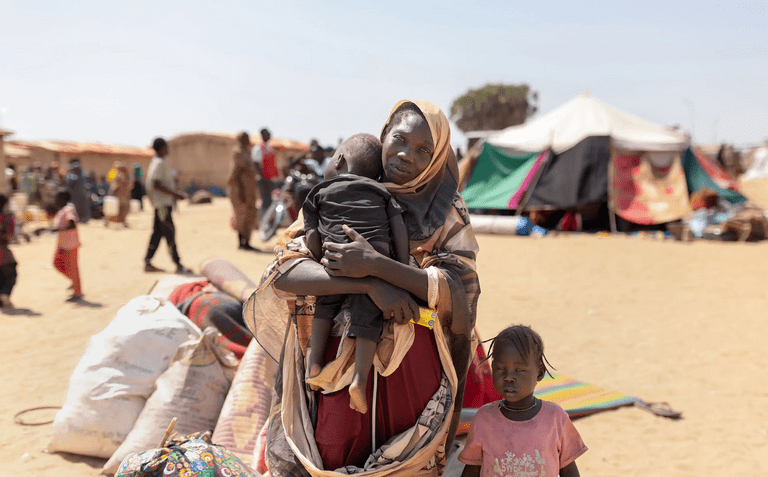
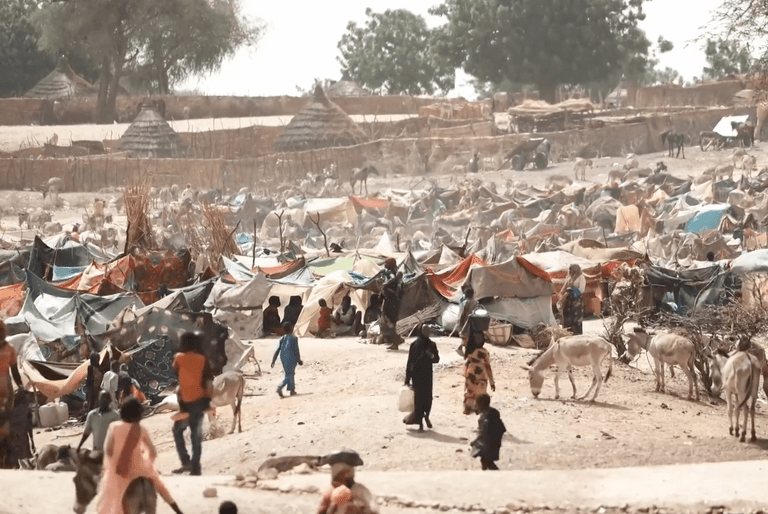
In addition to direct casualties, several areas report population displacement, destruction of critical infrastructure, and disruptions in access to healthcare, which intensifies the humanitarian crisis and increases the vulnerability of the civilian population.
Cooperation between TTP and BLA
It's worth noting that in 2026, cooperation between TTP and BLA strengthened. BLA announced Operation Operation Herof 2.0 in January 2026. It is a continuation of similar attacks carried out in August 2024. During this operation, the organization, using terrorist methods, attacked government facilities, police stations, prisons, and civilian infrastructure. For the first time, there was recorded interaction between TTP and BLA in conducting joint attacks against law enforcement agencies.
The collaboration of these two terrorist organizations elevates the conflict to a higher level. BLA can recruit additional fighters from TTP, while TTP can obtain more advanced weapons, including drones.
Attacks on civilian infrastructure
A particular concern is the attacks on civilian targets: in January, there was an attack on water facilities and a gas pipeline in Balochistan. The effect of such attacks is virtually null in material terms, primarily psychological — aimed at sowing panic and opening opportunities for recruitment. BLA actively highlighted Operation Herof 2.0 in its social media.
Tactics of Terrorist Attacks
Terrorists continue to actively use suicide bombers in their attacks. In July, there were 8 suicide attacks, 5 of which involved vehicle-borne improvised explosive devices (VBIEDs). Terrorists target not only law enforcement and government sites but also places with large gatherings of civilians: mosques, weddings, rallies, markets.
A separate concern is the widespread use of drones. TTP and other jihadist organizations use not only assault drones but also commercial ones to drop explosives.
In addition to mass terror, militants employ what are called targeted killings, aiming to eliminate opinion leaders. Kidnappings are also a frequent occurrence: in July, the number of kidnappings doubled from 33 to 66 cases. Opinion leaders, security officials, and representatives of provincial administrations are also kidnapped.
There are also certain concerns that ISKP cells have become active in the Khyber Pakhtunkhwa region. Militants are trying to impose competition on TTP in the province. The primary targets are Shiite sites.
State response
In response to terrorist attacks, the security services of Pakistan are conducting counter-terrorism operations and raids. In 2026, a total of 40,438 operations were carried out, resulting in the elimination of more than 2,084 terrorists — averaging about 10 terrorists per day..
Security forces emphasize "zero appeasement, zero tolerance." (no concessions, no tolerance). Negotiations with militants are officially prohibited.
And here lies a danger: intelligence agencies may conduct insufficient investigations regarding a person's ties to terrorist cells and, at the slightest suspicion during a raid, apply sanctions in the form of arrest or elimination.
We will continue to monitor the situation.
We are on social media
In addition to our website, we have social media. We run Telegram in Russian and Bluesky in English.
We remain an independent analytical project; we need your support — subscribe!


 Russian
  English